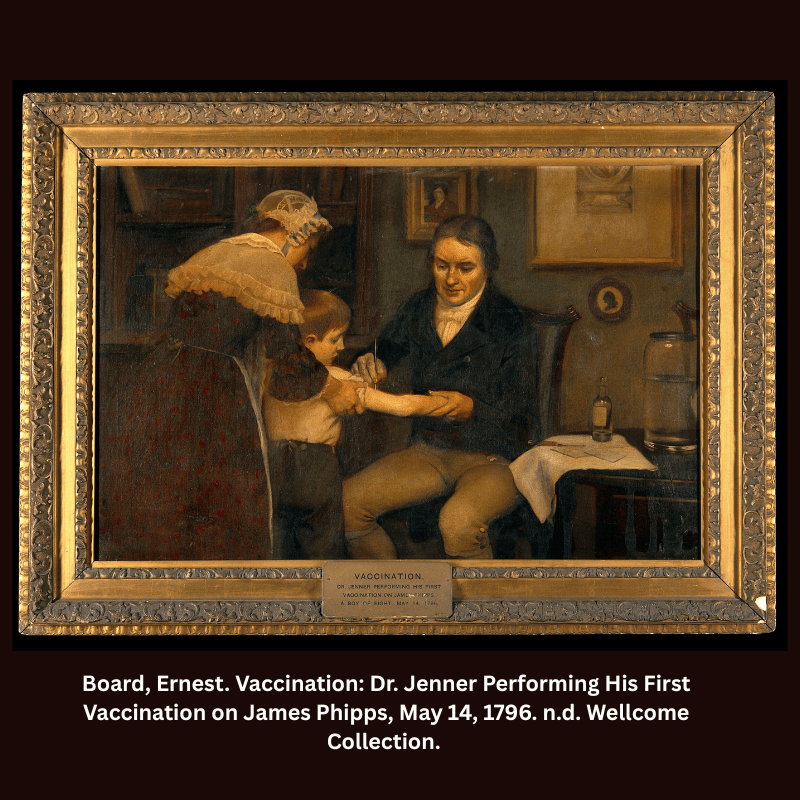
One of the earliest vaccine experiments was tested on a child. Edward Jenner wanted to prove that vaccination worked after observing that milkmaids who were getting infected with cowpox, rarely developed smallpox. Jenner wanted to test his theory that cowpox was somehow giving people immunity from smallpox.
He tested the experiment on an eight-year-old boy. The boy’s name was James Phipps. James was the son of Jenner’s gardener which matters because at the time, a lot of experiments were being performed on people with less social power. Phipps had no say or understanding in what was about to happen to him.
Jenner started by exposing the boy to cowpox. The boy became mildly sick with a fever and discomfort but eventually recovered. That alone was super risky. Once the boy recovered, Jenner exposed Phipps to smallpox which killed millions of people. If Jenner’s theory had failed, the boy could’ve died.
James Phipps never developed smallpox, the experiment actually worked. Jenner, however, didn’t stop there. He continued experimenting with the vaccine on other children including his own son.
Some may argue that it was a necessary risk because it saved millions of lives. I think the problem was experimenting on people who had no understanding of what was being done to them and couldn’t properly consent. My thought on this is that they could’ve experimented these vaccines on adults who could actually consent after understanding what exactly was being done to them.
This indeed makes me question why they felt so comfortable experimenting on children while holding back from testing adults. Were they afraid adults would cause more pushback? It is difficult to know exactly why Jenner chose a child rather than a consenting adult because historical records do not provide a clear answer. Interestingly enough, this didn’t seem to stop them in other experiments being done on adults who couldn’t consent.
The experiment changed medicine forever, but its controversial nature leaves many questions unanswered. Why didn’t he test himself? A friend? The gardener? It was a pattern of testing people who didn’t have much power, including orphans, prisoners, children, and immigrants.
There is no doubt that this discovery saved millions of lives. The debate is not whether vaccination worked. The debate is why so many early medical experiments were performed on people who could not truly consent.
Why children? Why not informed adults willing to accept the risk? These questions remain relevant today because they force us to examine how medical progress is achieved.
Sources
- Edward Jenner, An Inquiry into the Causes and Effects of the Variolae Vaccinae (1798)
- World Health Organization (WHO) resources on smallpox and vaccination
- Encyclopaedia Britannica: Edward Jenner
- National Library of Medicine historical resources
- JSTOR articles on vaccination history
- https://jstor.org/stable/community.24843804.
- Additional historical and academic sources consulted during research
Questions or thoughts?


Leave a comment