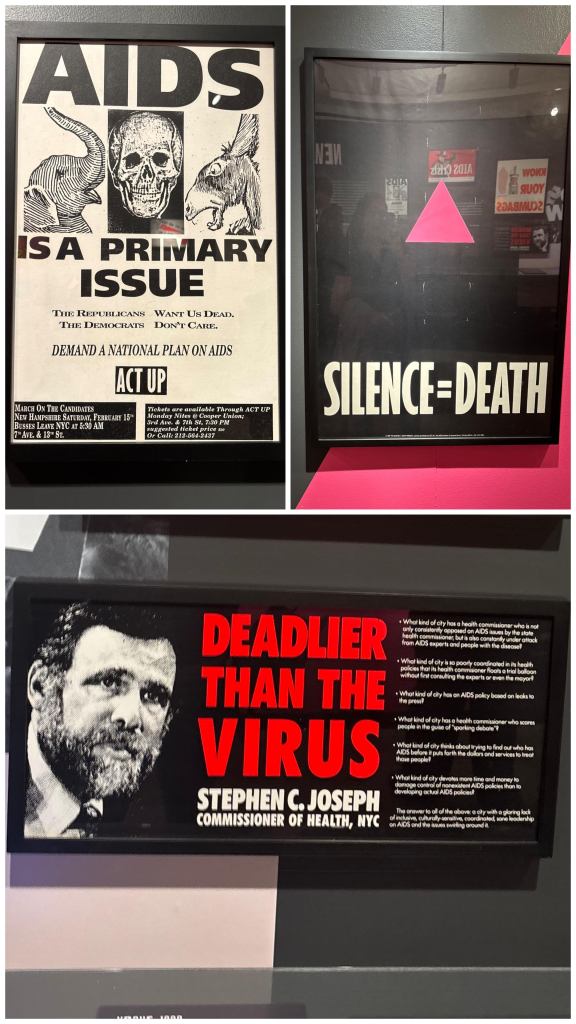
The Love and Furry exhibit was recommended as an extra credit opportunity in one of my history classes. Before visiting the exhibit, we had learned about Gaetan Dugas, often known as “Patient Zero,” and had also discussed a recurring historical pattern: when a new disease or a poorly understood behavior emerges, societies often associate it with a particular group or person. I couldn’t help but think about such themes as I walked through the exhibit.
Part of my fascination with history is how the public reacted to crises and how those crises were portrayed. In these posters, we can see how it was much deeper than just medicine. These posters are also political and spread awareness. They challenge people to speak up instead of panicking or becoming silent.
Through the many history topics that I have researched, I have noticed a pattern of blame. Anything that was considered harmful to people or the environment was often blamed on a particular group instead of focusing on the issues from a broader perspective and possibly improving the situation sooner.
If we take Gaetan Dugas, “Patient Zero,” as an example, he was incorrectly portrayed to the public as the man who “started” the epidemic in North America. Later, it was discovered that the phrase “Patient Zero” resulted from a misinterpretation of “Patient O,” meaning “Patient Outside of California.” Such a label impacted his life in very harmful ways and affected his family as well. These labels can be extremely harmful and raise questions about morality and ethics. How is it fair to blame an entire illness on one person just because that person was among the first to show symptoms in a particular area? Or because they were the first person comfortable enough to speak about it, or curious enough to know what’s happening to them? Is it okay to question and study that person when there are others carrying the same illness who show no symptoms or have not come forward?
This is a personal hot take, which I usually try to shy away from, but it does make me wonder whether, in the case of AIDS specifically, (though I think this for other illnesses as well), things might have unfolded differently if people had not been so focused on blaming gay men or so quick to label AIDS a “gay disease.” It makes me wonder if the cases could have been better controlled. If people had been more concerned about everyone being at risk, instead of focusing primarily on gay men, perhaps more people would have protected themselves. Instead, attention became heavily focused on one community.
I can sympathize with the political posters because I can understand how dismissive it must have felt when the illness was not only being mislabeled but when proper measures to protect everyone and spread accurate awareness were not being taken.
This is why, out of all the posters, these three stood out the most to me. I think spreading awareness is incredibly important when it’s done with consideration and with everyone in mind, rather than through blame and shame. I couldn’t even begin to imagine what it feels like to carry such a burden, especially when you have no idea of what is happening to you.
On the brighter side, the posters also show me resilience. They remind me that people stood up for what they believed was unjust and spread the word. Even when they felt like the world was against them, they kept fighting, one poster at a time.
Exhibit Information
Exhibit: Love & Fury: New York’s Fight Against AIDS
Museum: Poster House
Address: 119 West 23rd Street
New York, NY 10011
Exhibit Dates: March 13 – September 6, 2026
Website: Poster House (Official Website)
Note: Admission prices, museum hours, and exhibit availability may change. Visit the museum’s website for the most up-to-date information.
Questions or thoughts?

 Archives Headquarters
Leave a comment